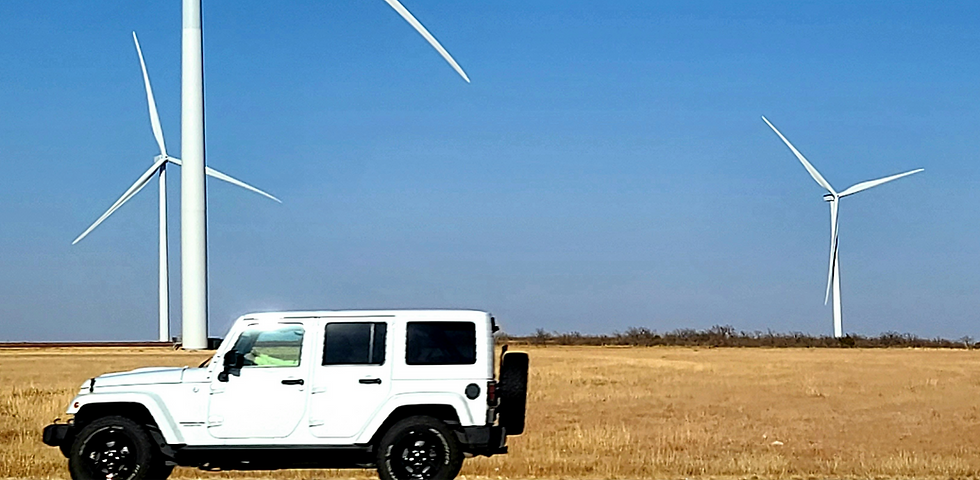
Harnessing New Mexico Wind:

State’s Fight to Win Hearts and Minds for Clean Energy
Third Way | Xochitl Torres Small, Emily Becker, & Maya Gibbs
October 22, 2025
Author’s note: This piece is based on over 15 interviews with people directly involved with or impacted by SunZia and Western Spirit Wind, with participants in both New Mexico and Arizona. Where possible, we identify participants by name and occupation, though some have requested anonymity to speak freely about the benefits and drawbacks of this historic energy project.
New Mexico is at the center of America's clean energy transition. With two large-scale wind and transmission projects, SunZia and Western Spirit, the state has attracted billions in private investment, created hundreds of jobs, and delivered new power to the grid, serving as a proving ground for what it takes to build clean energy at scale.
Some benefits are undeniable—new revenue for schools and local communities, economic lifelines for ranchers and landowners, and stable careers for the next generation of workers. But the successes don’t guarantee on-the-ground acceptance. Far too many good-paying construction jobs have gone to out-of-state workers, cutting New Mexicans and local unions out of deals in their own backyards. While some landowners and local governments have been able to negotiate directly with developers, tribal nations aren’t always treated similarly. And developers, hoping to build quickly, continue to face friction from environmental groups and a federal bureaucracy that is slow and prone to significant policy changes that create enormous market uncertainty.
To meet rising energy demand, the US will need many, many more clean energy projects like SunZia and Western Spirit. New Mexico's experience offers both a blueprint and a warning for the rest of the country. The path forward requires stability, creativity, and a commitment to leveraging clean energy investment to create enduring local benefits. Takeaways include:
Federal policies must both speed up permitting and spur meaningful early engagement with tribal nations and impacted communities—stable and effective policies targeting both permitting and engagement are badly needed and long-overlooked.
Community benefits must be front-loaded, offsetting some of the disruption of construction with local investments, sustained job creation, and tangible advantages for local communities.
States need more effective training pipelines for local workers and hiring standards that ensure clean energy jobs benefit surrounding communities.
Industry needs robust, stable leadership from state and federal policymakers to help de-risk major investments.
Big energy projects can certainly go wrong, with dire consequences for communities and business alike. But done right, large-scale projects like SunZia and Western Spirit can leave behind real opportunities for small communities, not just transmission towers and turbines.
Read the entire report here.